

Glycemic index: a practical guide to using it without counting anything
You’ve probably heard of “good carbs” and “bad carbs,” but the real difference between them isn’t about taste or calorie count — it’s about how fast the body turns that food into blood sugar. That’s the glycemic index (GI), a simple tool that can change how you choose meals, without obsessively counting anything.
What the glycemic index is
The glycemic index measures, on a scale of 0 to 100, how fast and how much a food raises blood sugar, compared to pure glucose (which has a GI of 100).
- Low GI (0-55): slow, moderate blood sugar rise — legumes, most vegetables, oats, most whole fruits
- Medium GI (56-69): moderate rise — brown rice, whole grain bread, sweet potatoes
- High GI (70-100): fast, large rise — white bread, french fries, white rice, sugary drinks, processed sweets
Why it matters for weight loss
High-GI foods produce insulin spikes. Blood sugar rises quickly, the pancreas releases insulin massively to normalize it, and this process can lead to a sharp drop in blood sugar 1-2 hours after the meal — the moment intense cravings appear, especially for sweets.
Low-GI foods maintain satiety longer. Slow digestion means gradual energy release and stable blood sugar, which translates to less hunger between meals.
Repeated insulin spikes favor fat storage, especially in people who already have insulin resistance — a vicious cycle where constantly elevated insulin worsens resistance, which in turn requires even more insulin.
The limits of the glycemic index (what it doesn’t tell you)
GI doesn’t account for the amount of carbohydrates consumed — watermelon has a high GI (72), but contains very few carbohydrates per serving, so the real impact is small. This is where glycemic load (GL) comes in, combining GI with the actual carbohydrate amount in a serving — a more practical real-world indicator.
GI also varies based on cooking (al dente pasta has lower GI than well-cooked pasta), ripeness (ripe bananas have higher GI than green ones), and combination with other foods in the meal.
How to apply GI practically, without counting anything
1. Always combine carbohydrates with protein, fiber, or healthy fats. A plain slice of white bread has a high GI; the same slice with peanut butter and an egg alongside has much lower glycemic impact on the overall meal, because protein and fat slow carbohydrate digestion.
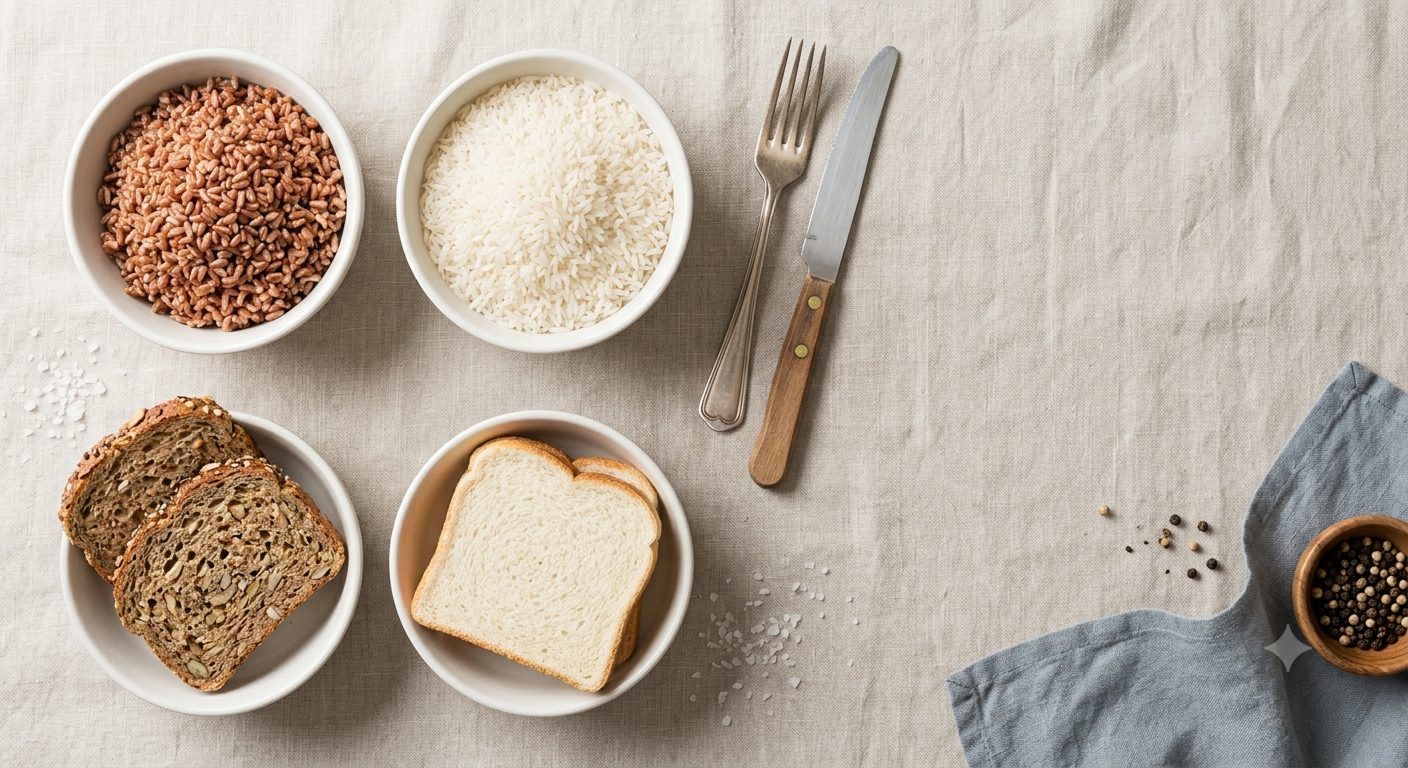
2. Choose the whole grain option instead of refined, systematically. Whole grain bread instead of white, brown rice instead of white, whole grain pasta instead of regular — the simple swap automatically reduces the meal’s glycemic impact without extra calculation effort.
3. Prioritize legumes. Beans, lentils, and chickpeas have very low GI, are rich in fiber and plant protein — an ideal combination for glycemic stability.
4. Don’t eat “naked” carbohydrates. A fruit juice without fiber has much higher glycemic impact than the whole fruit — the fiber in fruit slows sugar absorption.
5. Pay attention to food order within a meal. Studies show eating vegetables and protein before carbohydrates in the same meal reduces the blood sugar spike by up to 30%, compared to eating the same foods in reverse order.
Concrete lower-GI swaps
- White bread → whole grain rye or seeded bread
- Sugary breakfast cereal → plain oats with berries
- French fries → baked sweet potato
- White rice → brown rice or quinoa
- Fruit juice → whole fruit
- Cookie snack → a handful of nuts or Greek yogurt with fruit
Glycemic index and other diets
Many popular approaches partially rely on the GI principle without naming it explicitly — the Mediterranean diet naturally prioritizes low-to-moderate GI foods, and intermittent fasting combined with low-GI choices tends to give more stable results than combined with high-GI foods.
Who benefits most from this principle
People with insulin resistance, prediabetes, PCOS, or those who notice intense sweet cravings 1-2 hours after a meal benefit most visibly from paying attention to the glycemic index. For people without these issues, the principle still helps, but the effect is less dramatic.
Frequently asked questions
Do I need to completely eliminate high-GI foods?
No. Context matters — quantity, combination with other foods, and frequency. A small slice of watermelon occasionally has no real impact; a large glass of juice daily, yes.
Is the glycemic index the same for everyone?
Not entirely — it varies individually based on microbiome, insulin sensitivity, and other metabolic factors, but general classifications remain useful as a guide.
Fruits have high GI, so should they be avoided while dieting?
No. Most whole fruits have low-to-medium GI, and the fiber in fruit moderates the impact. The exceptions (watermelon, dates, very ripe bananas) still have nutritional value and can be consumed in moderation.
How do I find out a specific food’s GI?
There are online databases (the University of Sydney maintains one of the most complete), but for daily practical use, the simple rules in this article (whole grain vs. refined, combined with protein/fiber, whole fruit vs. juice) cover most situations without needing constant lookup.
The glycemic index isn’t a diet in itself, but a selection principle that, applied consistently, stabilizes energy, reduces cravings, and supports a sustained caloric deficit without constant hunger.
⚕️ The information in this article is for educational purposes and does not replace the advice of a doctor or nutritionist. People with diabetes should manage their blood sugar under medical guidance.