


Intermittent fasting 16/8: complete beginner's guide (meal plan, results, mistakes)
Intermittent fasting has a reputation that precedes it: for some it’s the secret of effortless weight loss, for others a dangerous fad. The truth, as usual, is less dramatic. The 16/8 protocol is neither magic nor dangerous — it’s simply a way of organising your meals that, for many people, makes it easier to eat less. That’s it. And precisely because “that’s it” sounds uninteresting, the internet has packaged it in all sorts of false promises.
Let’s take it seriously: what 16/8 actually means, why it helps with weight loss (and why not for the reason you think), what a real day of eating looks like, and what mistakes turn a simple protocol into a guaranteed failure.
What 16/8 actually means
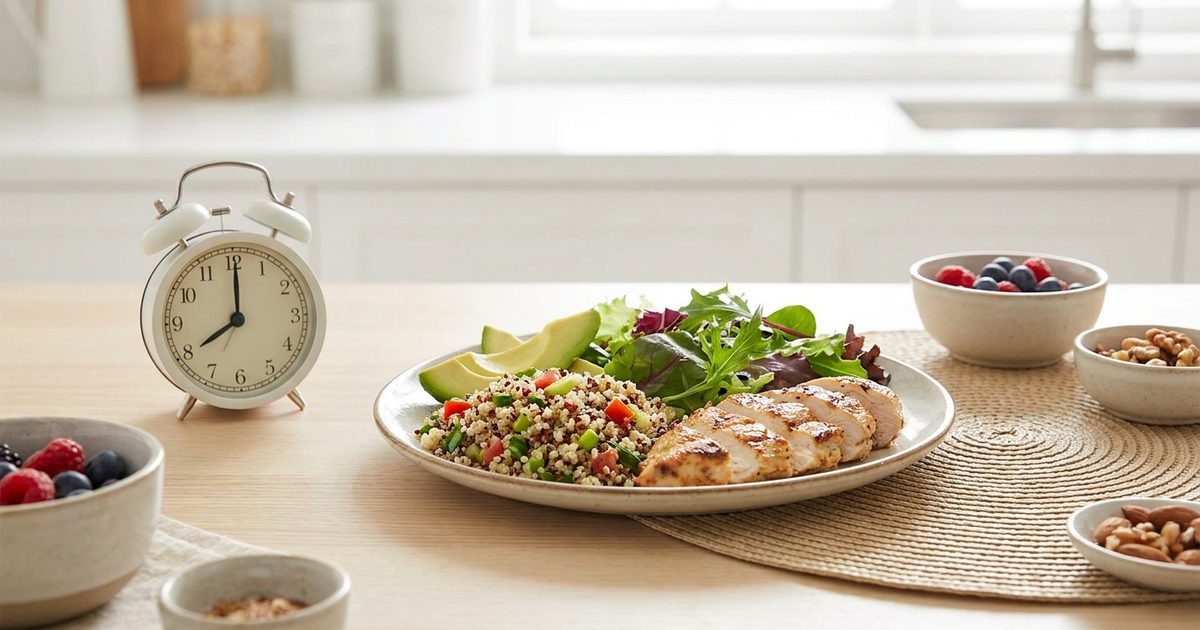
The rule is simple: you eat within an 8-hour window and fast for 16 hours. Intermittent fasting doesn’t tell you WHAT to eat, but WHEN. If your first meal is at 12:00, your last must be by 20:00. The remaining 16 hours — including sleep — are without food. You’re allowed water, black coffee, and unsweetened tea; anything with calories (milk in coffee, juice, a snack) breaks the fast.
The big draw is that you don’t count calories and you don’t ban foods. You simply have fewer hours in which you can eat, so you typically eat less overall. For someone accustomed to nibbling from morning to night, compressing into an 8-hour window naturally cuts many calories.
Why it helps you lose weight (and why NOT for the reason usually cited)
Here we need to debunk the biggest myth about intermittent fasting. The myth says that after 16 hours without food, you “enter fat-burning mode” and lose weight regardless of what you eat in the window. False.
Yes, during the fast insulin levels drop and the body uses more stored fat for energy. But at the end of the day, calorie balance is still what counts. If in those 8 hours you eat two pizzas and ice cream, you’re in a surplus and you gain weight — fast or not. Intermittent fasting only works if it helps you consume less than you burn, meaning a calorie deficit. It’s a tool that makes the deficit easier to maintain for certain people, not a loophole that cancels out the mathematics.
That’s why some people lose weight with it, while others complain they “kept the fast and still gained weight” — the difference is entirely what and how much goes into the window.
One-day meal plan (window 12:00–20:00)
To stop it being just theory, here’s what a normal day looks like, with accessible foods:
- 12:00 — first meal: omelette from 3 eggs with tomatoes and peppers, plus a slice of wholegrain bread. Protein and fibre that keep you full until the afternoon.
- 16:00 — snack: a Greek yogurt with a handful of nuts, or cottage cheese with cucumber.
- 19:30 — last meal: grilled chicken breast with a large salad and a tablespoon of olive oil, or baked fish with vegetables.
During the 16-hour fast: water, black coffee, unsweetened tea. Notice that the menu has nothing exotic and doesn’t leave you hungry — the secret isn’t what you eat, it’s that you no longer nibble between these meals.
What realistic results look like
Be sceptical of any promise of “minus 10 kg in a month.” Healthy weight loss means 0.5–1 kg per week, meaning 2–4 kg per month. In the first week you may see more on the scale, but it’s largely water, not fat (we explain why in the article about how many kg you lose in a month). Intermittent fasting produces visible results in 3–4 weeks if you’re consistent — and if the eating window doesn’t become a bingeing window.
The mistakes that ruin everything
The four most common traps, in the order in which they knock people off:
- You eat double in the window. The most common mistake. You “make up” at lunch for everything you didn’t eat in the morning and cancel the deficit. The fast is not an excuse to eat enormously in 8 hours.
- You drink calories during the fast. Coffee with milk and sugar, a “small” juice, a smoothie — all break the fast and, on top of that, add calories that don’t even fill you up.
- You quit after 3 days. The body needs about two weeks to adapt to the new schedule. For the first few days you may feel hungry at your old mealtimes; it passes.
- You ignore sleep and protein. Fasting on top of poor sleep and without enough protein leaves you hungry and without energy, and pushes you toward evening binges.
Frequently asked questions
Who does intermittent fasting 16/8 suit?
Those who prefer bigger meals and hate counting calories, and who aren’t breakfast eaters anyway. If you wake up hungry and function poorly without breakfast, it’s probably not for you — and that’s perfectly fine.
Does coffee break the fast?
Black coffee, without sugar and without milk, does not. The moment you add milk, cream, or sugar, you add calories and technically exit the fast. Unsweetened tea and water are always allowed.
Can I exercise on an empty stomach during the fast?
Yes, many people do it without problems. Light and moderate workouts go well; for intense effort, some feel low on energy. Listen to your body and stay well hydrated.
Who is NOT recommended to try it?
People with diabetes, pregnant or breastfeeding women, and anyone with a history of eating disorders — without medical clearance. Time restriction can be risky in these cases.
Is intermittent fasting more effective than a regular calorie-controlled diet?
Not intrinsically. Studies comparing intermittent fasting with a classic diet at the same calorie count show similar weight loss results. Fasting has no extra “magic” — its advantage is practical: for some people, it’s easier to skip breakfast than to weigh portions all day. If you find it easier to count calories, you’ll get the same results. The best diet is, ultimately, the one you can actually stick to.
If you want to try it, start simply: delay breakfast by one hour each day until you reach an 8-hour window, without changing everything abruptly. And remember the golden rule — the window controls WHEN you eat, but you control HOW MUCH. Put the numbers together with the calorie calculator and see the full protocol at Intermittent Fasting 16/8 in the diet library.
⚕️ This information is for educational purposes only and does not replace medical advice. Intermittent fasting is not suitable for everyone — consult a specialist if you have a medical condition.