
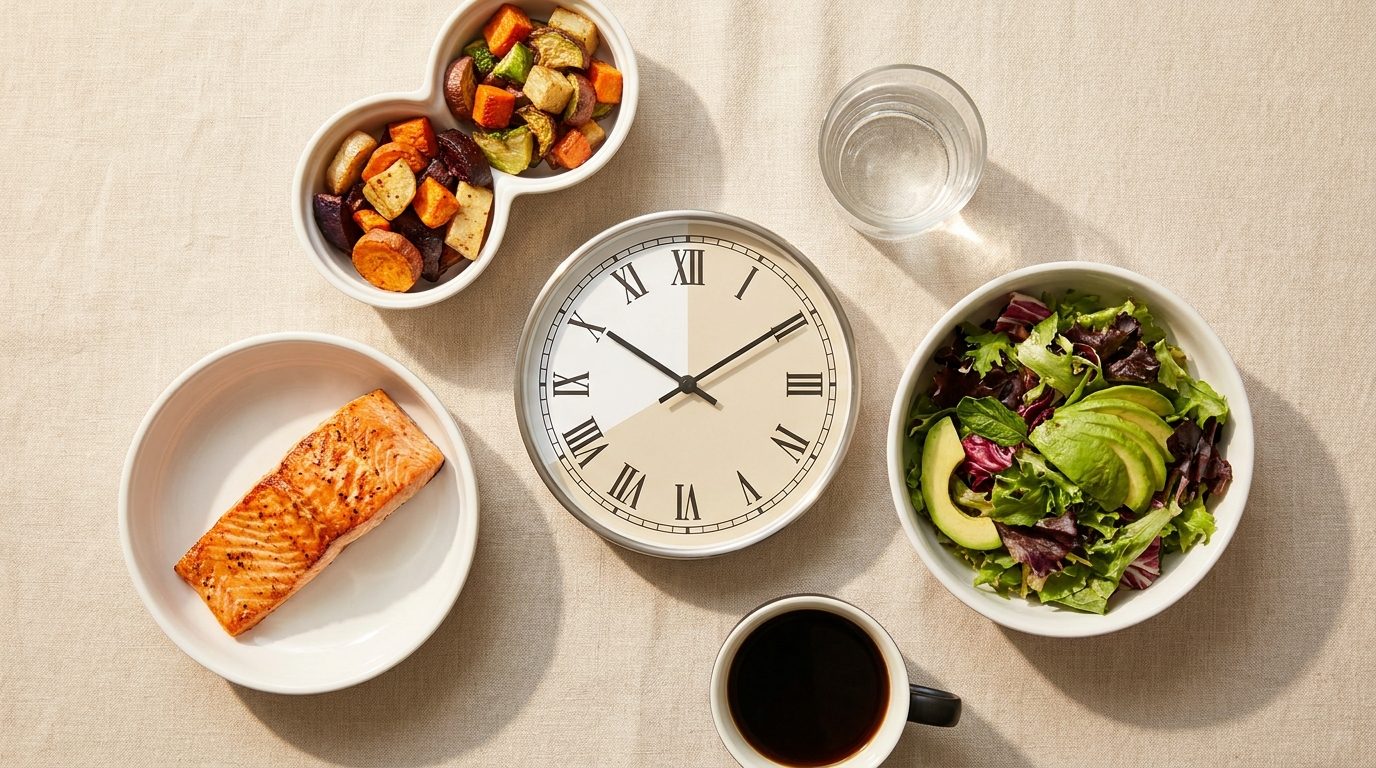
Intermittent fasting 5:2 and OMAD: more advanced variants beyond 16:8
Intermittent fasting 16:8 has already gone mainstream — 8 hours of eating, 16 hours of fasting, the cycle repeated daily. But for many, especially after a few months, 16:8 no longer produces results or becomes too easy to matter. Two more advanced variants are gaining increasing ground: 5:2 (eat normally 5 days, restriction two days per week) and OMAD (one meal a day). Both have solid logic behind them and documented results — but they don’t suit everyone or every circumstance.
The 5:2 fast — how it works
5:2 means that 5 days a week you eat normally (no caloric restrictions) and 2 days you restrict drastically — usually to 500 kcal for women, 600 kcal for men (about 25% of average caloric needs).
The two restriction days don’t have to be consecutive, but many do Monday and Thursday, or Tuesday and Friday — to have a normal day in between for recovery.
What you eat on restriction days (500–600 kcal):
- A small lunch (200–250 kcal): clear vegetable soup + a piece of chicken, or boiled eggs + salad
- A small dinner (250–300 kcal): grilled fish + steamed vegetables, or cottage cheese with tomatoes
- Water, tea, black coffee: unlimited
Normal days don’t mean eating without limits — they mean eating as usual, without thinking about calories.
Why 5:2 works
Weekly, you create a significant caloric deficit with just two days of restriction. If your needs are 2,000 kcal/day and you eat 500 kcal two days, you save ~3,000 kcal per week — equivalent to ~0.4 kg of fat.
But 5:2 has effects beyond simple caloric reduction:
Insulin sensitivity. Periods of deep caloric restriction reduce insulin levels more dramatically than moderate daily caloric restriction. Low insulin facilitates fat mobilization as an energy source.
Autophagy. Extended fasting (including a 500 kcal day is a form of near-complete fast) activates autophagy — the process by which cells “clean up” damaged components. Autophagy is linked to cellular health and longevity (the topic that brought Yoshinori Ohsumi the Nobel Prize in 2016).
Growth factors. Cyclical caloric restriction reduces IGF-1 (growth factor linked to cellular aging) and increases BDNF (factor that protects the brain).
OMAD — one meal a day
OMAD (One Meal A Day) is the extreme variant of intermittent fasting: you eat once a day, usually in the evening, and fast the remaining 23 hours.
The eating window is 1 hour (sometimes 2 hours). Everything you need to eat for that day must be consumed in that period.
Why people do it:
- Extreme simplicity — you don’t think about food all day
- Natural caloric deficit (hard to eat a full day’s calories in one session)
- Practical ease for people with busy schedules
- Strong effects on insulin and autophagy
The real problems with OMAD:
- Difficult to consume enough protein, fiber, vitamins, and minerals in a single meal
- Increased risk of muscle mass loss, especially without strength training
- Doesn’t fit social life (one meal = can’t eat with family or colleagues)
- Hard to maintain long-term
- Can worsen the relationship with food in people with restriction-binge tendencies
5:2 vs OMAD vs 16:8: which for whom
16:8 is ideal for:
- People new to intermittent fasting
- Those with a regular schedule who can skip breakfast
- Those who want long-term sustainability without extreme effects
5:2 is ideal for:
- Those who prefer eating normally 5 days and only “compensating” 2
- People with an active social schedule (don’t want daily restriction)
- Those who’ve plateaued with 16:8 and want a more effective variant
OMAD is better suited for:
- People experienced with intermittent fasting
- Those who function well with a single meal (and there are people who simply prefer that)
- Short periods of intense deficit, not necessarily permanent
Common rules for good results
Regardless of the variant chosen, a few principles apply to all:
Sufficient protein. Intermittent fasting doesn’t automatically protect muscle mass — if you don’t eat enough protein in eating windows, you lose muscle. Minimum target: 1.2–1.6 g protein per kilogram body weight. With OMAD, this can mean 100–120 g protein in a single meal.
Hydration during fasting periods. Water, tea, black coffee — essential. The feeling of hunger is sometimes confused with thirst. The headache from fasting is often an electrolyte imbalance, not real hunger.
Don’t “compensate” on free days (5:2). Normal days in 5:2 aren’t days of unlimited eating. If you eat 1,500 extra kcal on the 5 days to “compensate” for the restriction, the effect is cancelled out.
Nutritionally dense foods in the eating window. With OMAD especially, every calorie must count — you can’t just eat pasta and bread and be nutritionally complete.
Contraindications
5:2 and OMAD fasting are not recommended for:
- People with type 1 or type 2 diabetes on insulin therapy (hypoglycemia risk)
- Pregnant or breastfeeding women
- People with history of eating disorders
- Adolescents
- Underweight individuals
- Those with very intense physical activity and high caloric needs
Realistic results
Clinical studies on 5:2 (the most studied) show 4–8% body weight loss in 12–24 weeks — similar to continuous caloric restriction, but with some additional metabolic benefits (inflammatory markers, insulin).
5:2 isn’t magically superior to other methods — but it’s a valid alternative for those who don’t tolerate daily restriction.
Frequently asked questions
Can you exercise on restriction days (5:2)?
Light exercise yes. Intense training is not recommended — with 500 kcal, you don’t have the fuel needed and the risk of hypoglycemia or exhaustion is real.
Do you get used to the hunger on 5:2 days?
Yes, for most people. The first 2–3 weeks are the hardest. After that, the body adapts and restriction days become easier to tolerate.
Is OMAD compatible with strength training?
With difficulty. It’s hard to eat enough protein and calories in a single meal to support muscle growth. People who combine OMAD with strength training tend to have worse results for muscle mass compared to those eating 2–3 meals a day.
Can I combine 5:2 with keto?
You can — some do keto 5 days and restriction the other 2. It’s a combination that intensifies ketosis, but also harder to sustain and riskier without monitoring.
5:2 and OMAD are tools, not universal solutions. If 16:8 works for you, there’s no need to complicate things. If you’ve plateaued or want a more effective variant, 5:2 is a natural transition.
⚕️ The information in this article is for educational purposes and does not replace the advice of a doctor or nutritionist. If you have chronic conditions, consult a specialist before any form of fasting.