


Why am I not losing weight even though I eat little? 7 real causes and how to check them
“I eat like a bird and still don’t lose weight.” It’s one of the most common phrases you hear when talking about diets — and it’s almost never true in the way the person saying it believes. Not because people lie, but because “I eat little” is a feeling, not a measurement.
The good news is that in over 90% of cases, you don’t have a “destroyed metabolism” and you’re not a biological exception. One or two of the causes below are simply cancelling out your deficit without you noticing. Let’s go through them one by one, with things you can check starting today — not advice like “drink water and be patient.”
First, the mechanism: why the scale won’t budge
Weight loss has nothing to do with how “clean” or “healthy” you eat — it’s about the balance between the calories you consume and the calories you burn. You can eat nothing but avocado, nuts, and olive oil — all “healthy” — and gain weight, because they’re extremely calorie-dense. And conversely: people have lost weight eating ordinary foods, just in smaller amounts.
So when the scale doesn’t move even though you “eat little,” logic points to one thing: you’re not actually in a deficit. The right question isn’t “why am I not losing weight even though I eat little?” but “where are the calories I’m not seeing?” The 7 points below are the most common hiding places.
1. You underestimate how much you eat (much more than you think)
This is, by far, cause number one. Studies on this subject are almost comical: people underestimate what they eat by an average of 20–40%. A person who “eats 1,500 calories” is often eating 2,000 and sincerely believes they’re not.
Where it hides: a tablespoon of oil in the pan (120 kcal), three “bites” of your child’s food, a handful of grated cheese over your salad (~250 kcal), the bread slice that turns into four slices throughout the day. None of these seems large. Together they make the difference between losing weight and stalling.
Check today: write down everything — absolutely everything — for three days, including what you taste standing up. Weigh things; don’t “eyeball it” (your eye lies in exactly the direction that suits you). Compare with your requirement using the calorie calculator. In most cases, the mystery ends here.
2. You drink your calories without counting them
The brain doesn’t register liquid calories the same way as solid ones — they don’t fill you up, but they count just the same. A glass of juice (200 kcal), a coffee with milk and sugar in the morning and another in the afternoon (150–300 kcal combined), two beers on the weekend (300 kcal) — you’ve easily added 600–1,000 calories over the week without having “eaten” anything.
Juices and beer are the most insidious because we treat them as “nothing.” They’re not nothing.
3. You’re retaining water and confusing it with lack of progress
Your body doesn’t lose fat linearly, gram by gram, every day. It retains and releases water based on salt, hormones, stress, and workouts. A saltier meal yesterday (grilled meats, cheese, olives, deli meats) can make you weigh 1–1.5 kg more the next morning — and it’s entirely water.
Women see this clearly before menstruation, when retention can completely mask real weight loss for an entire week. If you weigh yourself daily and get frustrated by every fluctuation, you’re tormenting yourself needlessly.
Check: weigh yourself once a week, in the morning, before eating, on the same day. Look at the trend over three to four weeks, not today’s number.
4. You lost fat but also gained muscle at the same time
If you recently started exercising, especially with weights, something confusing can happen: you lose fat and gain muscle mass in parallel. On the scale it looks like “nothing is happening,” but your clothes fit differently and you look better in the mirror.
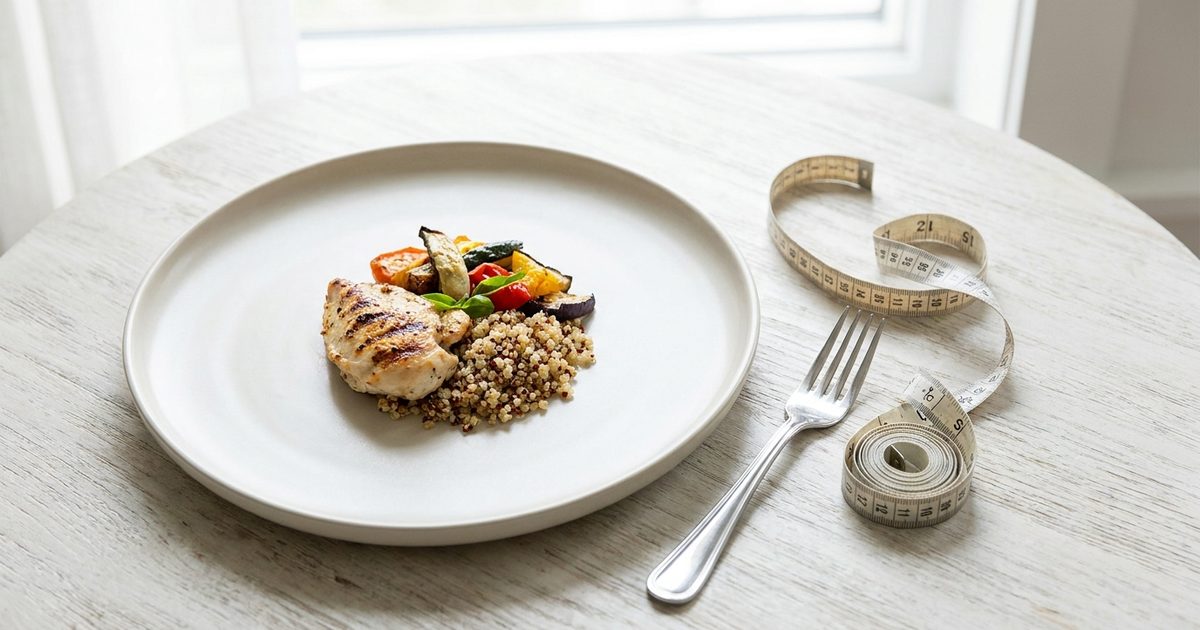
Muscle takes up less volume than fat at the same weight. That’s why the scale is a dishonest witness when you exercise. Measure yourself with a tape measure (waist, hips, thighs) every two weeks and take a photo. These tell the truth better than the scale.
5. The myth that ruins everything: “if I eat even less, I’ll lose weight faster”
This is the most widespread myth, and it deserves to be debunked clearly. Many people, when they see they’re not losing weight, cut even more — they get down to 1,000 calories, are constantly hungry, hold out for four days, then give in to an evening binge that cancels everything out.
The problem isn’t that “metabolism enters starvation mode” and magically blocks weight loss — that’s an exaggeration. The problem is behavioral: aggressive deficits can’t be sustained. You burn out, sleep poorly, become irritable, and statistically quit. A deficit of 300–500 calories sustained for three months beats any 1,000-calorie deficit held for five days. Weight loss is a patience game, not a suffering game.
6. You sleep poorly and don’t connect that to food
Two nights of five-hour sleep increases your appetite (especially for sweets and carbs) and weakens your willpower to say no. It’s not in your head — it’s the hunger hormones (ghrelin, leptin) going haywire. You can have a perfect diet on paper and sabotage it with a chaotic sleep schedule.
7. A real plateau, after you’ve already lost some weight
If you dropped 5–8 kg and then stopped, it’s normal and has a simple explanation: a smaller body burns fewer calories. The deficit you started with has shrunk on its own, because your calorie requirement has decreased. It’s not a failure — it’s physics.
The solution isn’t to starve yourself, but to make a small adjustment: recalculate your requirements at your new weight, and either reduce portions slightly or add 15–20 minutes of movement per day.
Frequently asked questions
Are there foods that “don’t make you gain weight” and that you can eat unlimited amounts of? Not exactly, but there are foods with low calorie density that fill you up with few calories: vegetables, salad, clear soup, low-fat cottage cheese, plain yogurt. You can feel full with a large bowl of these while consuming fewer calories than in a handful of nuts. “Unlimited” is a trap, but the margin is much wider.
How long should a stall last before I’m concerned? Three to four weeks of real stagnation (with correct, weekly weigh-ins) is worth a portion re-evaluation. Less than that, it’s very likely water or a week that was more relaxed than you think.
Could the thyroid or hormones be to blame? Yes, it happens — hypothyroidism, insulin resistance, or polycystic ovary syndrome can make weight loss harder. But they’re a less common cause than people think. If you eat in a controlled way and sleep well, and truly nothing moves for a few weeks, get some tests done and have a conversation with your doctor. Rule out medical causes; don’t assume them.
Does eating more frequently “speed up my metabolism”? No. The number of meals doesn’t change how much you burn — only the daily total matters. Some people do better with three meals, others with five. Choose what keeps you full and away from endless snacking.
If you’ve read to here and recognise yourself in the first two points, you also have the answer. Most of the time you don’t need a new diet — you need one week of honesty with your own food diary. Put the numbers on paper with the calorie calculator and re-read point 1 — statistically, that’s where the key is.
⚕️ This information is for educational purposes only and does not replace the advice of a doctor or nutritionist. If you suspect a medical cause, make an appointment with a specialist.