


Structured
RINA Diet (90-Day Diet)
Four-day cycle repeating over 90 days: protein day, starch day, carbohydrate day, vitamin day. A different food category at each meal. No calorie counting, but no mixing categories.
The RINA diet (also known as the 90-day diet) is a structured programme that cycles through four types of days over 90 days in a fixed repeating pattern: protein day → starch day → carbohydrate day → vitamin day.
The claimed logic: rotating food categories prevents metabolic adaptation and optimises hormonal response. The scientific basis for this mechanism is disputed — weight loss on the RINA diet is more likely attributable to the caloric restriction produced by the strict food-category rules.
The programme is popular in Eastern Europe (especially in former Yugoslav countries and Romania) because it offers a clear, rule-based structure without calorie counting, with a defined 90-day endpoint. Many people find the structure motivating, even if the theoretical underpinning is not scientifically rigorous.
History and origin
The 90-day diet was developed by Breda Hrobat and Mojca Poljanšek, two Slovenian nutrition consultants, who published it in Slovenia in the late 1990s under the name Dieta 90 dni. The name “RINA diet” that became popular in Romania and neighbouring countries refers to Rina Topič, a Slovenian television personality who promoted and popularised the programme, becoming its public face. Over time, “RINA diet” became the colloquial name, especially in the Romanian online space.
The programme spread rapidly through internet forums and word-of-mouth in the 2000s–2010s in Romania and other Eastern European countries, where it became one of the most searched diets online. It is notable that its spread was driven almost entirely by digital word-of-mouth, without major media appearances or clinical studies to support it.
There are no published randomised controlled trials specifically studying the RINA protocol. The few academic mentions are in observational context, noting its popularity and describing the protocol without clinical evaluation. Its success in the Romanian online space reflects a preference for structured, rule-based diets that provide clear guidance without requiring nutritional knowledge or calorie counting.
+ What you eat and what you avoid
✓ What you eat
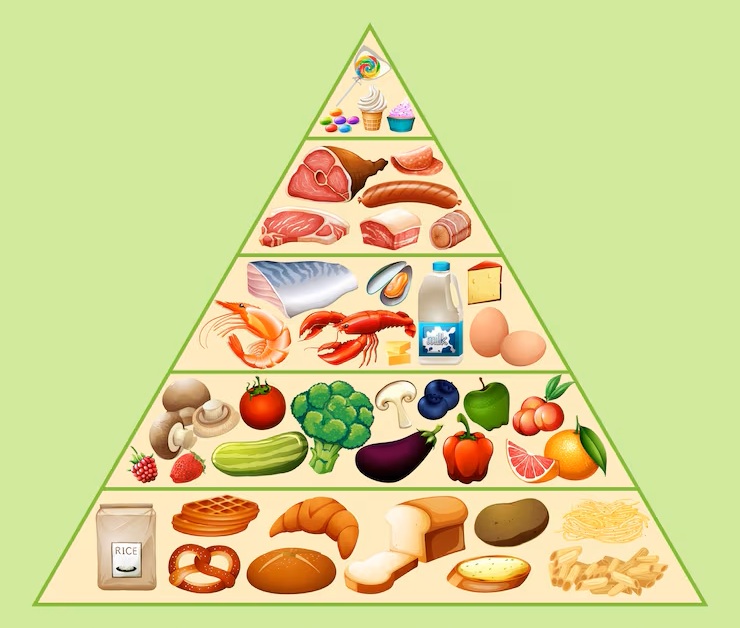
- Protein day: meat, fish, eggs, dairy (one category per meal)
- Starch day: whole grains, legumes, potatoes
- Carbohydrate day: fruit, cereals, pastries (less strict)
- Vitamin day: raw and cooked vegetables, fresh juices
✕ What you avoid
- Mixing categories between days
- Sugar and sweetened beverages (on all days)
- Alcohol
- Processed foods
+ Sample one-day menu
+ Pros and cons
Pros
- Structure gives clear direction for planning
- No calorie counting
- 90-day duration creates a clear endpoint
Cons
- The theoretical basis (hormonal cycling from food type rotation) is not well scientifically supported
- Complex to follow — different rules every day
- Risk of nutritional imbalance on individual days
- Weight loss attributed to caloric restriction, not the rotation mechanism
+ ⚠️ Who should avoid this diet
- Pregnant women and children
- People with diabetes — carbohydrate day requires monitoring
- Not recommended without medical supervision for people with chronic diseases
Indicative list. Before starting any diet, especially if you have a medical condition, consult a doctor or nutritionist.
Întrebări frecvente
What does RINA stand for?
RINA is the first name of the Slovenian author, Rina Topič, who popularised the 90-day diet in the former Yugoslav countries in the 1990s–2000s. The programme was later published and spread to other Eastern European countries, including Romania.
Why four types of days?
The RINA theory claims that rotating food categories every day prevents the body from 'adapting' to a certain type of food, maintaining an elevated metabolism. This mechanism has no solid scientific basis — the metabolic adaptation to food type rotation has not been demonstrated in controlled studies.
Is the RINA diet recommended?
It is a structured programme that has helped many people lose weight — mainly through caloric restriction that results from the food-type rules. The rotation mechanism itself is not scientifically proven, but the structure may be motivating for people who need a clear framework.