

Strength training for women: why lifting weights won't make you "bulky"
“I don’t want to get bulky” is the most common reason women avoid the weight room and stick to cardio. It’s one of the most persistent myths in fitness, and one of the costliest — because strength training is actually one of the most effective tools for weight loss and for looking exactly the opposite of what most women fear.
Why you won’t bulk up like a bodybuilder
The “bulky” look of professional bodybuilders is the result of years of specific training, calculated eating in a massive caloric surplus, and, in many cases, supplemental testosterone (natural or exogenous). Women have on average 15-20 times less testosterone than men — the main hormone responsible for massive muscle hypertrophy. Without that hormonal level, the female body physically cannot build muscle at the rate and volume associated with the “bodybuilder” image.
What actually happens when a woman lifts weights consistently: muscles become denser and more toned, not bigger and bulkier. The difference between “toned” and “bulky” isn’t a matter of training intensity — it’s hormonal physiology.
What strength training does for weight loss
Burns calories during and after the workout. An intense strength session burns calories directly, but keeps burning calories for hours afterward — the EPOC effect (excess post-exercise oxygen consumption). Cardio burns more calories during the session, but almost none afterward.
Increases basal metabolism. Every extra kilogram of muscle burns approximately 13 kcal per day just to exist, versus 4-5 kcal for a kilogram of fat. Doesn’t sound like much per kilogram, but the compounded difference long-term, plus the effect on body composition, matters significantly.
Protects muscle mass during dieting. When you’re in a caloric deficit, the body burns both fat and muscle unless you give it a reason to keep the muscle. Strength training is that reason — it signals to the body that muscle is needed and should be preserved, while fat is what should be sacrificed.
Improves body composition, not just the number on the scale. Two people with the same weight can look completely different if one has more muscle mass and less fat. Strength training is the primary tool for changing that ratio.
Cardio vs. strength: what to choose for weight loss
It’s not a competition — the two complement each other. But if you have to choose where to invest your limited time, research consistently shows that a combination with emphasis on strength gives better long-term results than cardio alone, for the simple reason that it preserves the muscle that keeps metabolism active.
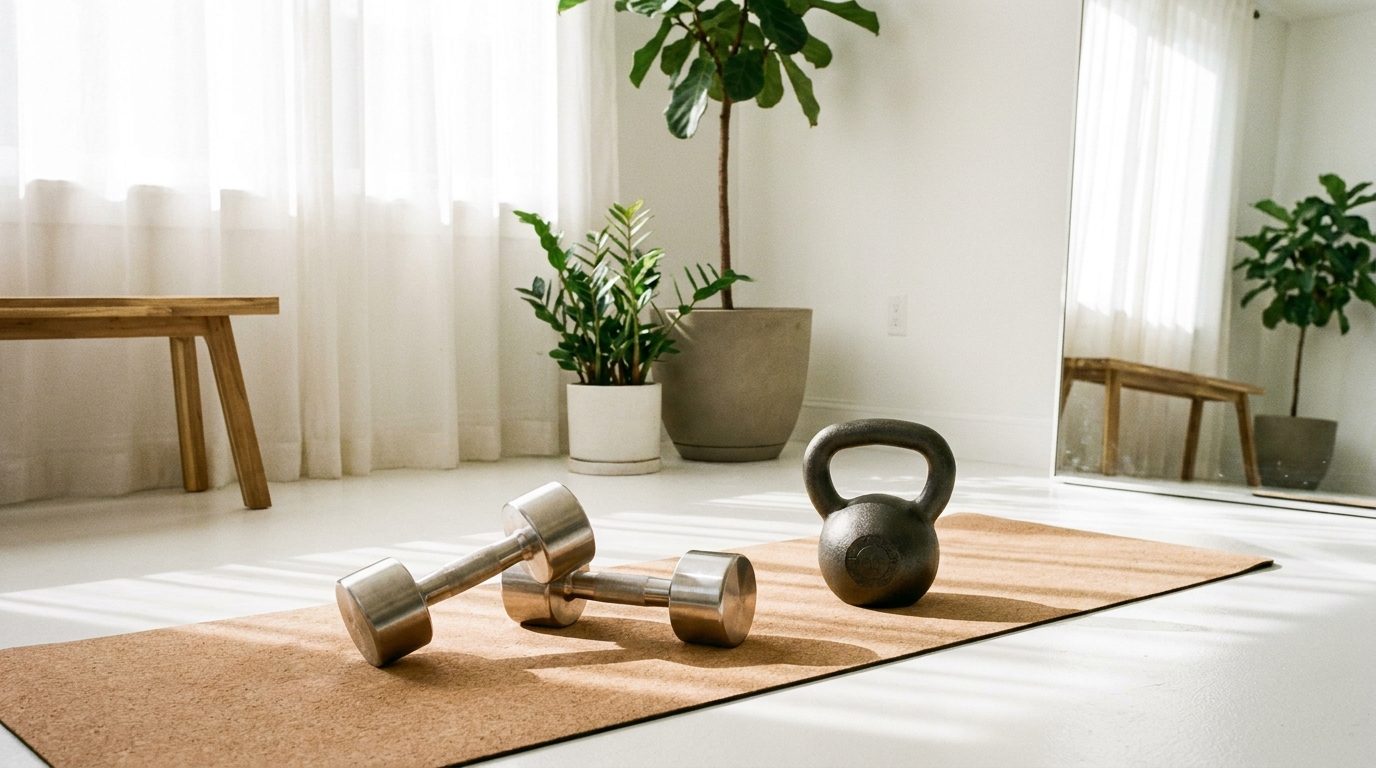
A balanced program: 2-3 strength sessions per week + zone 2 cardio 2-4 times per week. You don’t need an elaborate gym — free weights, resistance bands, or even bodyweight (squats, push-ups, planks) work.
What a basic program for beginners looks like
Frequency: 2-3 sessions per week, with a rest day between them for muscle recovery.
Basic exercises (compound, move multiple muscle groups):
- Squats — legs, glutes
- Chest press (bench press or push-ups) — chest, triceps
- Rows or pull-downs — back, biceps
- Deadlift (lifting weight from the floor) — back, glutes, legs
- Overhead press — shoulders
Progression: Start with weights you can lift 10-12 times with moderate effort (not maximum). Increase weight gradually, every 2-3 weeks, when exercises become easy.
Rest between sets: 60-90 seconds for small exercises, 2-3 minutes for heavy compound exercises.
What happens to the body in the first weeks
The first 4-6 weeks, muscles adapt neurologically — you learn the movement, coordination, and control, before visible muscle growth appears. It’s normal not to see dramatic changes immediately. Real strength gains and toning become visible after 6-12 weeks of consistency.
Some women notice a slight temporary increase on the scale in the first weeks — it’s not fat, it’s water retention from normal muscle inflammation associated with adapting to a new stimulus. It disappears within 2-3 weeks.
Related myths to debunk
“Lifting weights will make my arms like a man’s.” False, for the hormonal reasons explained above. Arms become more defined, not bulkier.
“Cardio is better for losing weight fast.” Cardio burns more calories per session, but without strength training, a significant portion of weight lost is muscle mass — which slows metabolism long-term and favors the yo-yo effect.
“You need to do thousands of reps with light weights for toning.” Toning is a combination of visible muscle (i.e., lower body fat percentage) and trained muscle. Heavier weights with moderate reps (8-12) build muscle more efficiently than very long sets with light weights.
Frequently asked questions
How long until I see results?
Strength changes appear in 2-4 weeks. Visible body composition changes (toning) usually appear after 8-12 weeks of consistent training combined with adequate nutrition.
Do I need to eat more protein if I do strength training?
Yes. To build or preserve muscle mass while dieting, the target is 1.2-1.6 g protein per kilogram of body weight.
Can I do strength training if I’m over 50?
Yes, and it’s more important than ever. Muscle mass naturally declines with age (sarcopenia), and strength training is the most effective tool for slowing this process.
Do I need a gym membership?
Not necessarily. Resistance bands, adjustable dumbbells, or even bodyweight exercises at home can build an effective program for beginners.
Strength training doesn’t just fail to make you “bulky” — it’s one of the most effective factors for looking toned, losing weight sustainably, and protecting your long-term metabolic health.
⚕️ The information in this article is for educational purposes and does not replace the advice of a doctor or specialized trainer.