
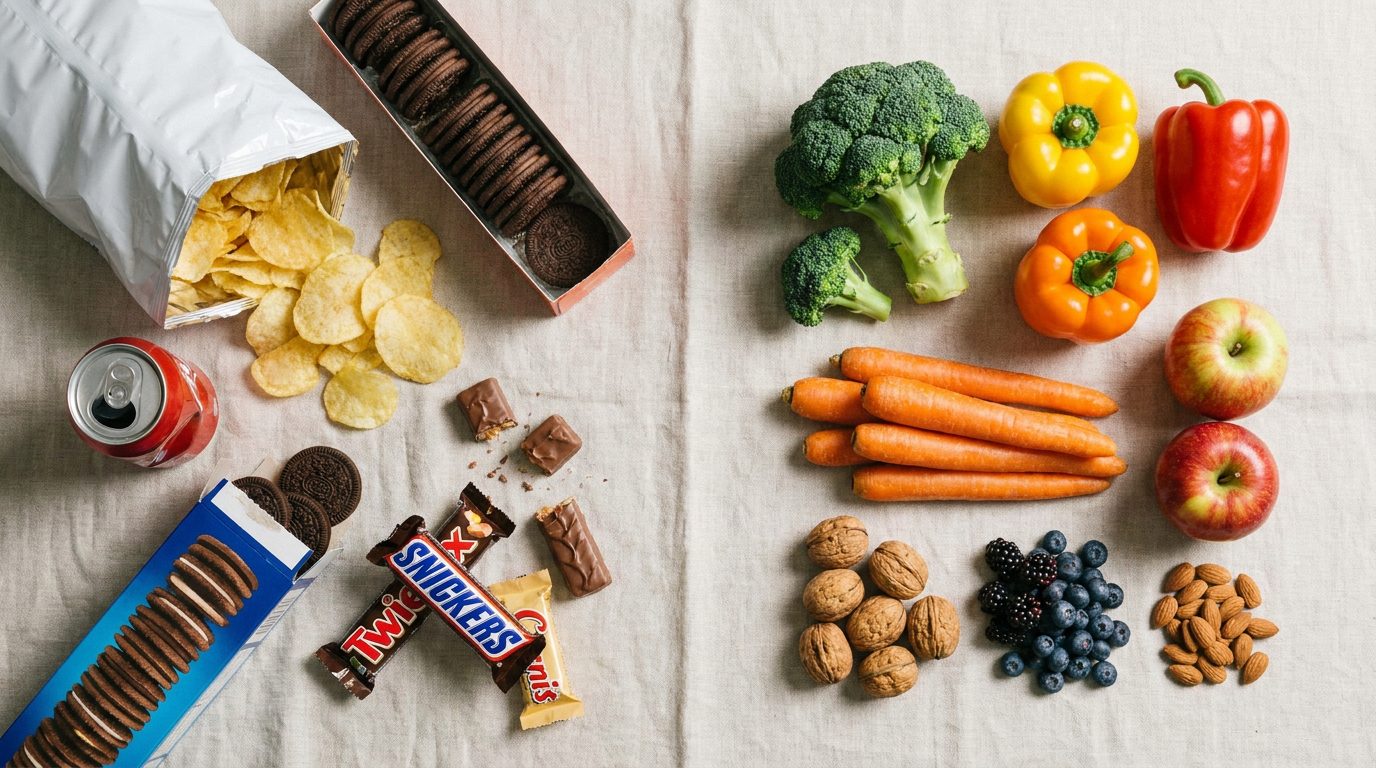
Ultra-processed foods: why they make you gain weight even at the same calorie count
The calorie theory is simple: eat more than you burn, you gain weight. But if it’s that simple, why do people who count calories to the decimal still struggle to lose weight? Part of the answer lies in the type of food, not just the quantity of calories. Ultra-processed foods are at the center of this discussion, and recent research is clear enough to take seriously.
What “ultra-processed” means
The NOVA classification divides foods into 4 groups based on degree of processing:
- Group 1: Unprocessed or minimally processed foods — fresh vegetables, fruits, meat, eggs, milk, legumes
- Group 2: Culinary ingredients — oil, butter, sugar, salt, flour
- Group 3: Processed foods — artisan bread, canned vegetables, simple cheeses
- Group 4 — Ultra-processed: industrially manufactured products with ingredients you wouldn’t find in a kitchen — emulsifiers, artificial flavors, stabilizers, sweeteners, colorings
Concrete examples of ultra-processed foods:
- Chips, cookies, packaged pastries
- Breakfast cereals (especially the sugary ones)
- Cold cuts (sausages, pressed ham, bologna)
- Soft drinks, flavored juices
- Packet soups, packaged sauces, industrial mayonnaises
- Nuggets, frozen burgers
- Flavored yogurt with added sugar (not plain)
- Industrial white toast bread
Why they cause more weight gain than their calories suggest
A landmark study published in Cell Metabolism (Kevin Hall, NIH, 2019) compared two diets with the same calorie count: one ultra-processed, one from whole foods. Participants could eat as much as they wanted from both. Result: those eating ultra-processed foods spontaneously consumed 500 extra kcal per day and gained weight, while the whole foods group lost weight. Same calories available, completely different results.
Why this happens:
1. Eating speed. Ultra-processed foods are soft, small, and don’t require much chewing. You eat fast. The satiety signal reaches the brain ~20 minutes after starting a meal — if you eat fast, you’ve already consumed far more than needed.
2. Hyperpalatability. The industrial combination of sugar + salt + fat + artificial flavors activates the brain’s reward centers more intensely than any natural food. It’s designed to make you want “more” — not from hunger, but from pleasure.
3. Missing fiber. Ultra-processed foods are usually fiber-poor. Without fiber, there’s no real satiety, digestion is rapid, and hunger returns soon.
4. Disrupted hormones. Emulsifiers and additives disrupt the gut microbiome, which affects production of satiety hormones (GLP-1, PYY). Long term, the body “no longer knows” when it’s full.
5. Insulin on a rollercoaster. The fast sugars in ultra-processed foods cause blood sugar spikes followed by crashes — the cycle that produces intense cravings 1–2 hours after eating.
How much do we consume
Studies from multiple countries show ultra-processed foods represent 40–60% of daily calories for the average adult in Western countries. The trend isn’t limited to any single region — the rise of supermarkets, takeaway food, and cheap packaged foods has changed what people eat.
The association with obesity is consistent across studies from dozens of countries: every 10% increase in the proportion of calories from ultra-processed foods correlates with a 2–3% increase in obesity risk.
What this doesn’t mean
It doesn’t mean every packaged food is dangerous. Canned tuna in water, canned beans, crushed tomatoes, or plain yogurt are processed, but not ultra-processed. The difference is in the ingredient list — if you find things you wouldn’t put in a kitchen (emulsifiers like E471, artificial flavors, glucose-fructose syrup, preservatives), it’s probably ultra-processed.
It also doesn’t mean you have to eliminate them completely. If 80% of your diet comes from whole and minimally processed foods, the remaining 20% of processed items isn’t a catastrophe.
How to reduce ultra-processed foods without overhauling your life
Simple swaps:
- Chips → plain popcorn or carrots with hummus
- Sugary breakfast cereal → oats with fruit
- Juices → water, lemon water, or tea
- White toast bread → whole grain bread (with short ingredient lists)
- Cold cuts → boiled eggs, plain cheese, tuna in water
- Packaged cookies → fruit or nuts
The ingredient list rule. If the list has more than 5–7 ingredients and includes words you don’t recognize, consider whether it’s the right product for the base of your diet.
Home cooking is the most effective filter. Not because you need to be a chef — an egg and vegetable omelette, a simple soup, or baked chicken with potatoes are home-cooked and are completely incompatible with an ultra-processed ingredient list.
Frequently asked questions
Are all E-numbers bad?
No. E-numbers are simply food additives approved in the EU. Some are completely benign (vitamin C is E300, for example). The problem isn’t the E itself, but the combination of many additives in a product, especially emulsifiers (E4xx) that disrupt the gut microbiome.
If they’re organic, are they better?
Not necessarily. An organic cookie with organic cane sugar is still an ultra-processed product. “Organic” refers to how the ingredients were produced, not the degree of processing.
Can I lose weight eating ultra-processed foods if I control calories?
Technically yes, short term. But studies show it’s much harder to control calories when eating ultra-processed — you eat faster, feel less full, and have more cravings. Caloric control is easier with whole foods.
Are children more affected?
Yes. The taste for hyperpalatable food forms in childhood. Children raised on ultra-processed foods have a greater preference for them later and greater difficulty with moderate portions.
Ultra-processed foods aren’t poison, but they have one important property: they’re designed by entire teams of food engineers to be impossible to eat in moderate quantities. That makes them incompatible with any diet — not for philosophical reasons, but for concrete hormonal and neurological ones.
⚕️ The information in this article is for educational purposes and does not replace the advice of a doctor or nutritionist.